
The Airline Behind the Airline
You board a flight and see two pilots, four or five cabin crew. Six people, maybe, in uniform.
By the time your seatbelt clicks shut, well over a thousand people have already had a hand in that flight. You never met a single one of them.
Here's who they are, working backward from the moment you booked.
Months before you even think about the trip: Network Planning
Long before a route appears on a booking site, someone at the airline has already decided it should exist. That's Network Planning's job, and it's part chess, part guesswork.
They study where people actually want to travel, how often, and whether an aircraft on that route will turn a profit. Daily flights or four a week? A narrow-body or a wide-body? Can the plane fly there and straight back for another trip, or does it need to park overnight? These calls get made here, often a year or more before tickets even go on sale.
They're the airline's cartographers, in a way: not just deciding where the plane goes, but whether it should go there at all.
While you're still deciding where to go: Revenue Management & Pricing
Airline ticket prices move for a reason. Search again a few hours later and the number can be different, and that's down to Revenue Management, not chance and not your search history.
This team decides how many seats get sold cheap early, how many get held back for the last-minute traveller who'll pay more, and how the price climbs as the flight fills up. The goal is simple to state and hard to do: sell every seat for the most the market will pay, without leaving the plane half-empty. It's one of the most influential teams in the building, and almost nobody outside the industry has heard of it.
The moment you book: Sales, Marketing & Distribution
Whether you booked on the airline's app, its website, through a travel agent, or a search engine, a separate team made sure that seat was visible to you in the first place.
Sales and Distribution manage the pipes connecting the airline's inventory to every place a ticket can be bought, including the systems travel agents use worldwide. Marketing decides how the airline presents itself: the campaigns, the loyalty programme, the reason you picked this airline over the one next to it.
The day before: Crew Scheduling
Somewhere in a control room, months of planning come down to one practical question: which pilot and which cabin crew are actually on this aircraft, on this day?
Crew Scheduling, sometimes called Rostering, builds and rebuilds that puzzle constantly. Every crew member has legal limits on flying hours, required rest periods, and licences or training that must stay current. One pilot calling in sick in one city can send this team reworking rosters for a dozen flights within the hour. Few jobs in the airline involve this much constraint-solving, and few get this little credit.
The night before: Engineering & Maintenance
While you're packing your bag, the aircraft you'll fly is being inspected, and sometimes partly taken apart and put back together.
Engineering and Maintenance, often shortened to MRO (Maintenance, Repair and Overhaul), carries one non-negotiable responsibility: the aircraft has to be certified airworthy before it's allowed to fly. Some checks happen nightly. Deeper structural inspections happen only every few years, and can ground an aircraft for weeks at a time. Nothing on the schedule matters until this team signs off.
The morning of: Ground Operations
Long before boarding starts, a lot of people are working underneath and around the aircraft. Ground Operations covers the ramp team guiding the aircraft into its parking spot, the baggage handlers loading your suitcase, the fuel crew, the catering trucks, and the pushback tractor that moves the plane out before engines start.
It's physical work on a tight clock. An aircraft sitting at the gate longer than planned costs the airline money directly, and the delay can carry into the rest of the day's schedule.
Check-in and the gate: Airport & Customer Service
This is the part of the airline most passengers actually meet: the check-in counter, the gate agent, the person who helps when a bag is overweight or a flight is delayed. Airport and Customer Service carry the weight of everything the other departments have already done, and they're the ones standing there when something has gone wrong.
Also happening at the same time: Cargo
Passengers aren't the only thing on board. Most passenger aircraft also carry cargo in the belly hold, everything from parcels to fresh produce to, occasionally, medical shipments that can't wait. Cargo sells and manages that space, and on some routes it's the difference between a flight making money and not.
Boarding: Cabin Crew
By the time you step onto the aircraft, the cabin crew have already been through a full briefing: safety equipment checks, emergency procedures, who covers which exit, and any passengers who need special attention. Their training centres on safety first. The service and the smile, which is what passengers actually notice, comes second.
Pushback: Flight Operations, Dispatch & the Pilots
Before a wheel moves, a Flight Dispatcher, a role almost no passenger has heard of, has already built the flight plan: route, altitude, exact fuel load, weighed against weather, wind, and which airspace the aircraft is even allowed to cross. In most of the world, the dispatcher and the captain both have to sign off on that plan before departure.
Then the pilots fly it. It's one of the most trained, tested, and regulated jobs anywhere, with regular simulator checks required just to keep the licence valid.
While you're in the air: Operations Control
Somewhere on the ground, a team is watching your flight the whole way, along with every other aircraft the airline is flying that day, all at once. The Operations Control Centre (OCC) tracks weather, air traffic delays, technical issues, and crew legality in real time, and makes the calls when something shifts mid-schedule: delay this flight, swap that aircraft, reroute a crew about to run out of legal hours. Network Planning designs the airline on paper. The OCC is what keeps it running, minute by minute, on the actual day.
Running underneath everything, always: The support functions
None of the above works without teams that rarely get a mention but hold the company together: Finance (keeping the airline solvent in a business famous for thin margins), Human Resources (hiring and training thousands of staff in a heavily regulated field), IT (the booking systems, apps, and operational software everything else runs on), Safety and Quality (checking that every other department is actually meeting standards, not just writing them down), and Corporate Communications (speaking for the airline when things go right, and more so when they don't).
The quick version
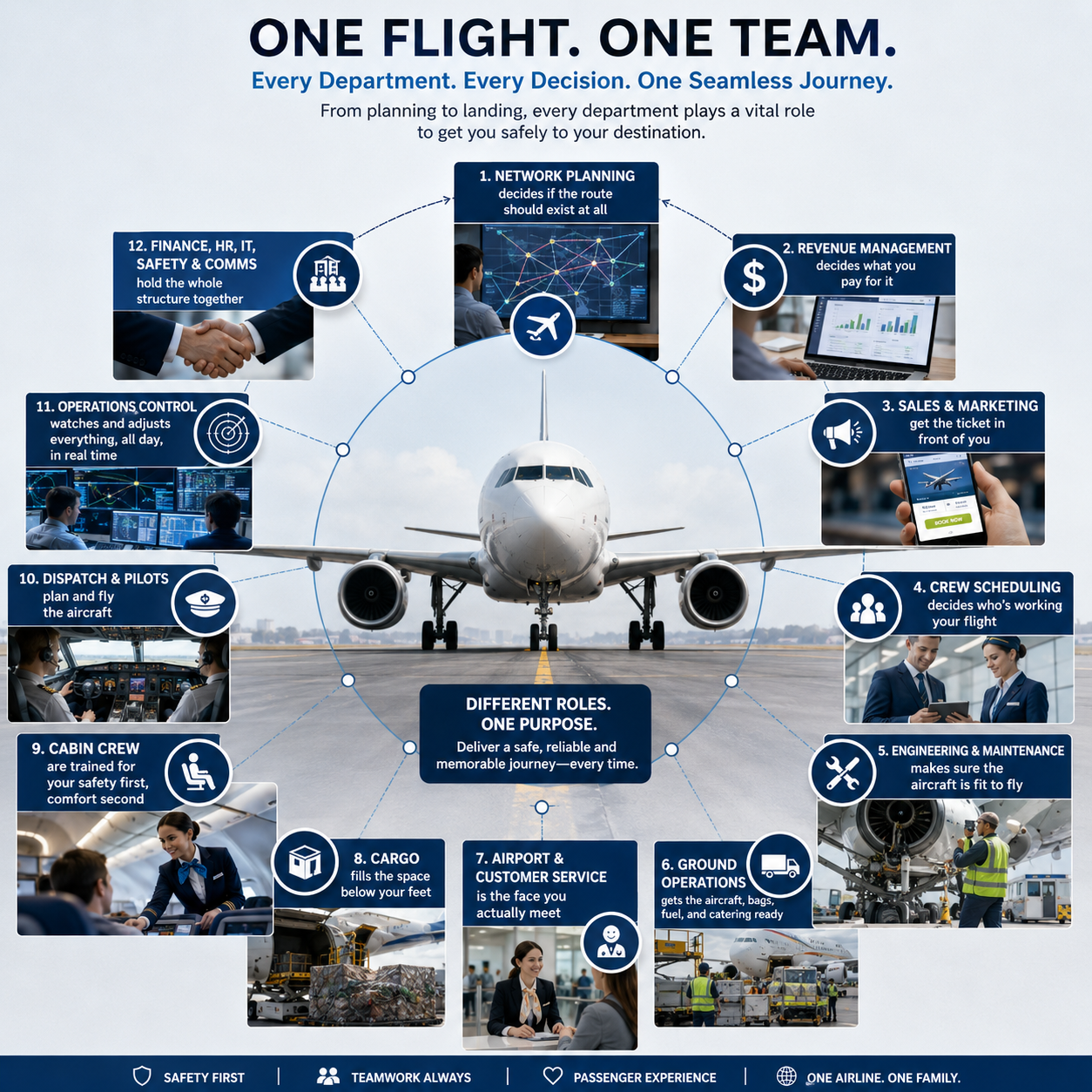
A flight isn't really run by the pilots and cabin crew you see. It's run by a chain of departments passing the job to each other, most of which you'll never see or hear about.
Network Planning decides if the route should exist at all
Revenue Management decides what you pay for it
Sales & Marketing get the ticket in front of you
Crew Scheduling decides who's working your flight
Engineering & Maintenance makes sure the aircraft is fit to fly
Ground Operations gets the aircraft, bags, fuel, and catering ready
Airport & Customer Service is the face you actually meet
Cargo fills the space below your feet
Cabin Crew are trained for your safety first, comfort second
Dispatch & Pilots plan and fly the aircraft
Operations Control watches and adjusts everything, all day, in real time
Finance, HR, IT, Safety and Comms hold the whole structure together
Next time you're in seat 14C, somewhere over the clouds: getting you there wasn't the work of one team. It was a long chain of handoffs, most of them invisible, that all came together the moment you walked down the aerobridge.
This article is part of TraviationX's ongoing series on how the aviation industry actually works, written for professionals, aspiring aviators, and anyone who's looked out of a plane window and wondered who made that flight possible.